Hey therapist, I’m Allyson

Raging against the toxic messaging that therapists have to choose between doing good and doing well.
LICENSED CLINICAL SOCIAL WORKER & YOUR PRIVATE PRACTICE CONSULTANT & WINGWOMAN
There is a parallel process between therapy & business ownership…
I see it every day: therapists who skillfully guide clients through resistance, avoidance, and fear, then get caught up in the exact same things when it comes to their business.
Have you ever found yourself doing any of these things?
You encourage clients to invest in their growth - therapy, coaching, courses that will help them - while telling yourself, “But I can’t afford business help.”
You explore and challenge their limiting beliefs about what's possible for them, while holding onto “But marketing gives me the ick.”
You hold space for their discomfort as they face hard truths and make difficult changes, while stepping back from your own when it’s time to look at your numbers.
Therapist, it’s time to change this.
You already know how to guide people through discomfort. Those same skills translate to building your private practice.
The difference is having someone who understands both the clinical world AND proven marketing strategy to walk alongside you. It’s me, hi.


What I’ve learned about running a successful, premium-fee private therapy practice…


01
Running a premium-fee private practice often brings up the same unfinished business that therapy does: your relationship with money and success, your boundaries, issues of worthiness and believing you can and should take up space as an expert, your visibility fears and anxieties, etc.
That ish all comes up to the surface when you market your practice.
And when these issues stay unaddressed, they often sabotage your marketing efforts. You’ll procrastinate, undercharge, or write copy that plays it safe instead of positioning you as the expert you are.
I’ll walk with you through the uncomfortable parts, like raising rates or claiming your expertise publicly, but my clients need to be ready to take action despite the discomfort.
02
The therapists who thrive as business owners actually aren’t the ones with the most clinical certifications, or the ones who practice in high-cost-of-living areas, or the ones who see clients in person.
They’re the ones willing to learn marketing strategy and keep it updated as their practice (and the market) changes, even when it’s uncomfortable and doesn’t bring overnight results.
Business ownership isn’t a one-and-done skill; it’s a practice that constantly evolves (quite similar to therapy!).
It requires the same commitment to growth and distress tolerance that effective therapy does.
Here’s the reality: Therapists can’t build a sustainable practice while avoiding the psychological and financial realities of being a business owner.
03
The therapists who get the best results aren’t the ones who learn the most tactics. They’re the ones who get their clarity right first: meaning, who they’re for, what they do, and why it matters to that specific person.
And then they build everything else on top of that.
Tactics work when the foundation is solid. Without it, you’re just getting visible to people who aren’t sure you’re the right fit for them.


When I applied my strategy to my own private practice, here’s what happened:
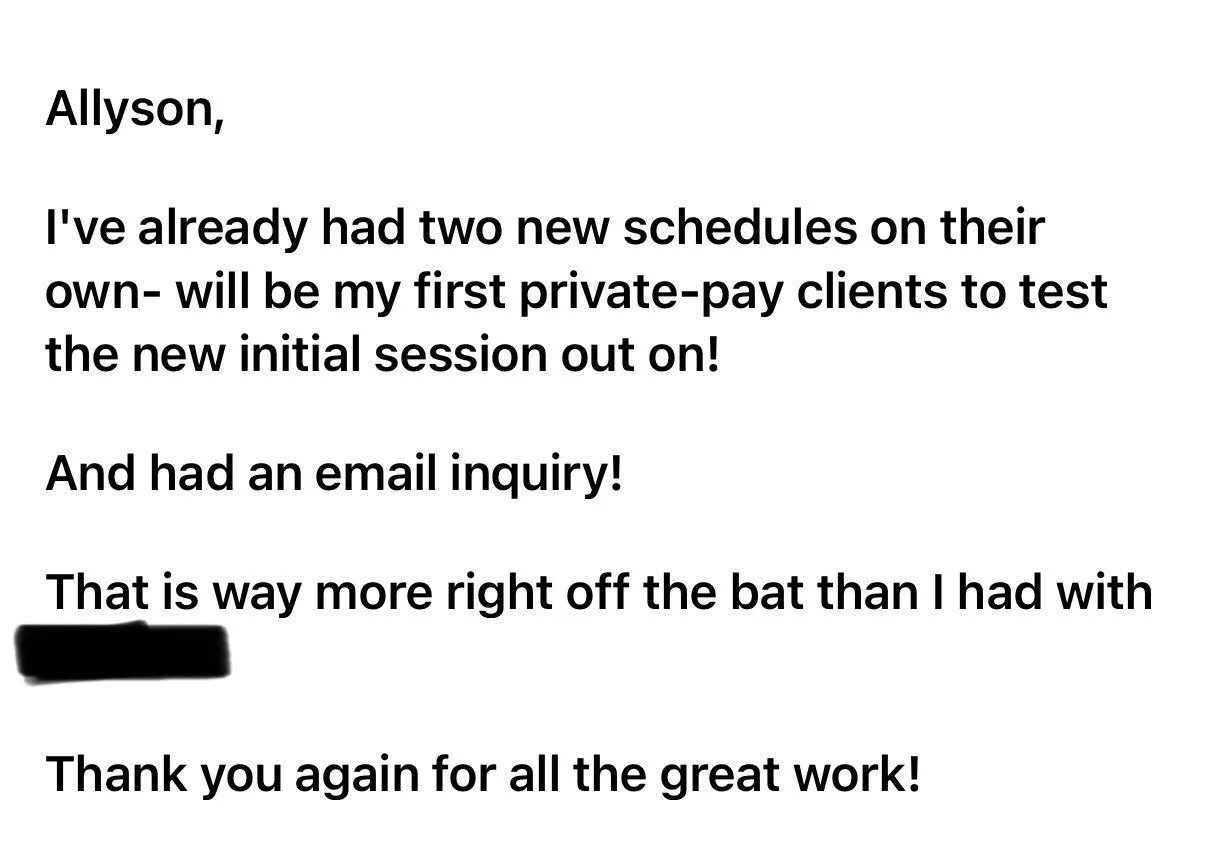
Dropped insurance and raised my rates from an average of $89 to $400 per hour — when your marketing content positions you as the solution, clients see the value
Earned about $180,000 in one year with an average of 10 sessions a week — premium rates give you a full-time income with the time and energy to have a life outside your practice
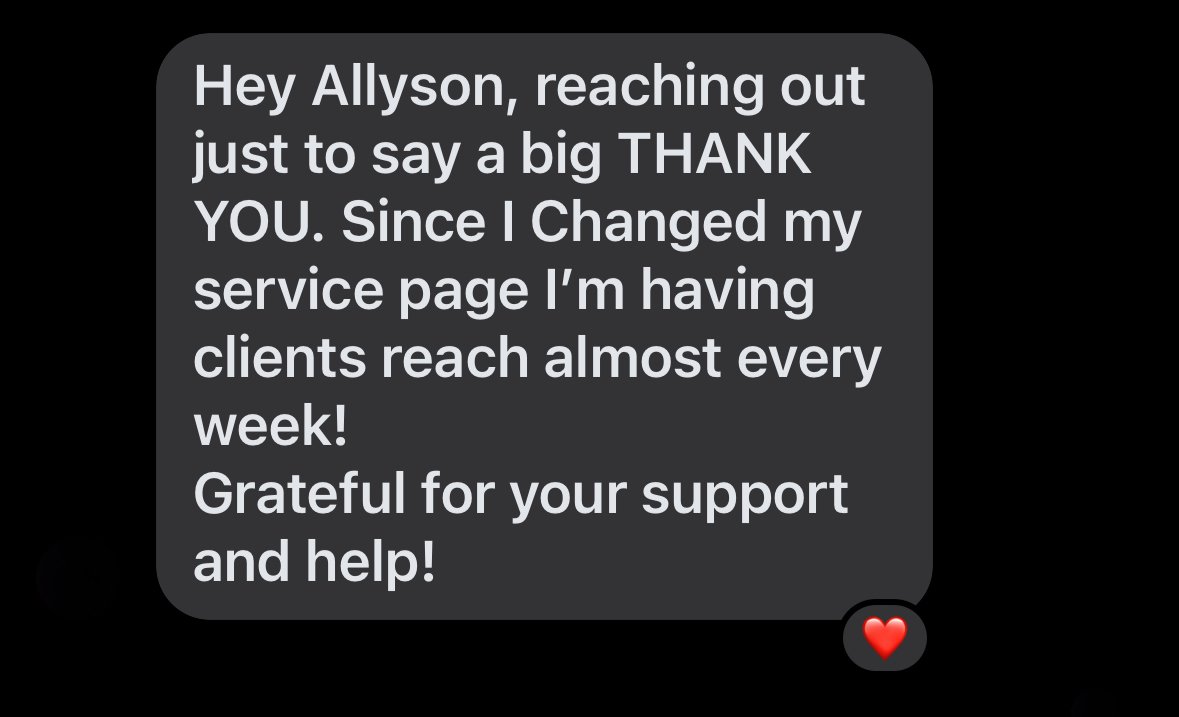
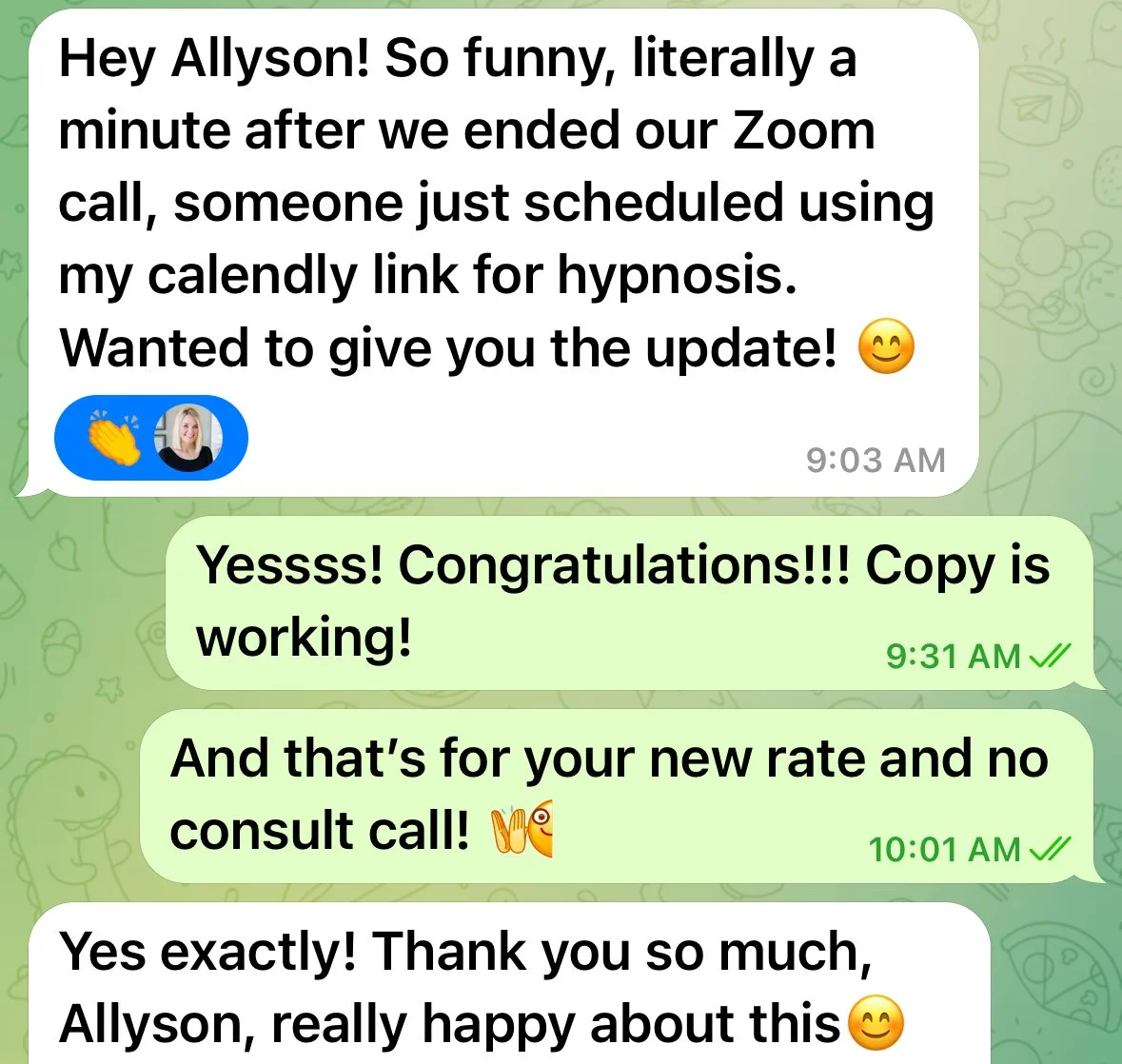
Stopped offering free consult calls, yet I still have a full caseload and inquiries while I sleep — my website content does the heavy lifting of selling for me
Celebrated my highest income month in private practice: over $21,000 — this is possible when you attract clients who are ready to invest
Consistently fill (even overfill!) my seasonal group therapy spots, year after year — targeted copy attracts the right people
Work remotely from all over the world— I currently live in Mexico (and Europe before that!) — virtual networking and SEO make location independence possible
Now I support my consulting clients in reaching the goals they’ve set for their own practices, whether that means raising their rates, seeing fewer clients, leaving insurance panels, or working from anywhere.





What you should know about my experience, beliefs, opinions, and philosophy about owning and marketing a private therapy practice before we work together…


→ About therapy clients, money, accessibility, and practice sustainability…
There’s no “right” or “wrong” about how clients pay for therapy. A client who uses insurance can be just as committed to therapy as a client who pays out of pocket, and a client who pays out of pocket isn’t necessarily “more ready” or “more committed” to the therapy process than an insurance or sliding scale client. And I reject the notion that “if a client values themselves or values therapy, they’ll find a way to pay your rate.” That might be true. And it can be (and is) also true that a client can value therapy and their mental health, and still be objectively unable to afford paying privately for therapy. Both can be true at the same time. RUN from anyone who suggests otherwise.
That being said, how a client pays to work with you is part of fit. Years ago, a therapist I really wanted to work with, but absolutely could not afford to work with, told me that “price is part of fit” and I never forgot it. “Goodness of fit” does NOT only include clinical problems or how you and a client click. That was true when you worked at an agency. But in private practice, it also includes how financially sustainable the relationship will be for both parties long-term.

A practice HAS to be sustainable for the therapist who owns it. Your prices, practice policies, and caseload need to add up to an income you can sustain for years without burning out. Otherwise, the future of our field is at risk.
A therapist who burns out and/or leaves the field is the MOST inaccessible therapist out there. You aren’t, and can’t be, held responsible for fixing your country’s mental health access problems on your own. Gaps in insurance coverage, low reimbursement rates, and long waitlists are healthcare systems problems, and a therapist who tries to solve them by taking on more low-paying clients than they can sustain often burns out (and sometimes leaves the field of therapy altogether!), and can’t be of service or help to anyone.
I don’t believe accessibility should be the primary goal of a private practice. The exception to this is if you have other income or savings, and you’re making a deliberate pricing choice with eyes wide open. A therapist with a salaried job or a partner’s income can choose to keep prices low, but a therapist whose practice is their only income has to charge a price that supports them and their life first, or they simply won’t be able to keep practicing.
Every price point excludes someone. Some people can’t afford $400 a session, some can’t afford $10, and some can’t afford the time that weekly therapy takes, no matter the price. So, I don’t believe in setting my rate by asking who it potentially leaves out. I also never spend time trying to convince anyone that my rate should work for them. I’m only concerned with explaining clearly how I can help the people who can pay my rate, and I leave it up to them to decide whether I’m the right fit.
→ About clinical experience, specializing, and niching down…
Generalist, community-based mental health experience is one of the most valuable clinical foundations a therapist can have. I firmly believe every therapist should have experience with some genuinely hard, complex client cases before going into solo private practice. I spent 12 years working in substance use treatment, hospitals, and County mental health, where I learned to assess complicated situations, treat several overlapping problems at once, work in multidisciplinary teams, and understand how systems affect mental health access and care. This type of work experience challenged my biases and assumptions and made me a much more skilled and attuned therapist. I wouldn’t trade those experiences for the world.
That being said, niching down and owning a specialty that you get better at year after year builds a different, equally important, kind of clinical skill, as well as a reputation in your community. And by the way, I will die on the hill that, for the vast majority of private practice therapists, niching down is the faster and easier way to fill a private pay practice than staying a generalist.

→ About marketing a private practice as a therapist…
Filling a private pay practice takes a different, sometimes opposing, skillset than being a therapist. Therapists with full private pay caseloads have learned to market and sell their services to the clients who are the best fit for them, and that marketing skill is separate from how good they are at therapy. I believe the marketing skills needed to fill a private pay practice in the modern day are sometimes in opposition to our clinical philosophies and skillsets, which is a huge reason therapists can struggle with the mindset and boundaries necessary for successful business ownership more so than other professionals.
Marketing foundations MUST come before marketing tasks. Foundations are the decisions about who you’re the best fit for, which problems and situations you help clients with, and why a client should choose you. Tasks and tactics are what you DO to get those clients to find you (ads, SEO, directories, speaking, and social media). A Google ad can bring someone to your website, but if your foundations aren’t in place, that potential client won’t know why they should work with you as opposed to another (cheaper) therapist, and they’ll bounce. You’ve paid for a website visitor that didn’t become a paying client.
Marketing tasks without foundations waste the most time and money. Starting with visibility tasks, like ads or SEO, to fill a private practice is popular, sexy, and easy-to-sell advice. And it’s also the most unpredictable, expensive, frustrating, and demoralizing way to market a practice. I believe this is why so many therapists end up suspicious and jaded when it comes to private practice business coaching — even when the coach is skilled and well-intentioned.
While marketing requires significant upfront effort, it shouldn’t require ongoing hustle. I don’t want ongoing hustle in my own marketing, and I don’t want to teach it. The marketing I teach requires effort upfront, but it’s also low ongoing maintenance, with a website, SEO, and some (light) content when necessary. I don’t do or teach methods that require churning out written or video content. Ain’t nobody got time for that.
→ About investing in your practice and buying courses, programs, and coaching…
1-1 support is what makes courses work, which is why I always include it. Participants put course theory and teachings into practice when they have someone to answer their individualized questions, give feedback on their drafts, and catch mistakes before those mistakes cost them time, money, or potential clients.
Your financial investment in business support should match your stage of business. A therapist who is starting out in private practice, or even a seasoned therapist testing a new ideal client or a new service, is still learning what works. In that case, programs and courses in the $1k–$3k range are a fit, because they cover the foundations and leave room to change direction without a huge loss. Once you’ve tested your service and clients are booking it, a much bigger investment ($5-10k+) then makes sense, because you’re scaling and amplifying something that already brings in clients and income. My own offers follow this logic: my done-for-you offer, The Profit-Ready Practice, costs $20k and is NOT meant for a new practice owner. Its job is to multiply the revenue of a practice that already has proven foundations and is bringing in some consistent income. On the flip side, Positioned for Profit IS meant for a practice owner who doesn’t yet have proven foundations and consistent income, and typically costs $697 during a sale, which is a price that matches the stage of business of someone getting their bearings.
I’m wary of expensive programs for therapists who are just starting out. There are two big reasons for this: 1) When a beginner spends $8-$10k on a course or program, that type of price usually locks a person into a direction for their practice they may not be ready for (because they are new), and they may ultimately change their mind about. This leads the person to feel like the investment was “wasted” when really, it was simply a financial overcommitment for someone just starting out. And, 2) a new practice can take much longer to earn that money back, so a big cost can become a burden before the practice has a chance to grow and see a return on the investment.
I’m not a fan of DIY in business because the cost of DIY is too high, even though it’s invisible. Here’s what I mean: when you figure out marketing alone, you spend months, if not years, on trial and error. And you lose the income you could have earned during that time if you’d started out with the right support. Often, the income lost over time by DIY-ing is much higher than what a course or program costs.
That being said, the best way to build a business is from a regulated emotional state, rather than from desperation, anxiety, or financial stress. Not everyone has the money to hire business support right away. That’s why, for a lot of therapists, the most sustainable path to private practice is to keep an agency job or stay on insurance panels for a set amount of time while they build, learn, and experiment with their own practice. That way, they aren’t under pressure to make money immediately (which usually leads to poor decision-making). A new practice rarely brings in a full-time income quickly, so steady income coming from somewhere else gives you room to make decisions based on what fits your practice rather than on what will pay this month’s bills.