How to Get Private Pay Therapy Clients in 2026

I’m Allyson.
I’m a therapist in private practice and a marketing consultant who works exclusively with therapists.
I built a six-figure practice on less than ten clinical hours a week, and now I help other therapists do the same.

You raised your fee, dropped insurance, maybe got a few new trainings, and now your caseload is quieter than you expected.
You’re checking Psychology Today more than you’d like to admit, refreshing your inbox hoping for an inquiry that doesn’t come, and starting to wonder if you should just get back on panels.
I see this all the time in therapist communities. Someone raises their rate to $200, drops their panels, and within a few weeks they’re in a Facebook group asking why their caseload isn’t full. And 99% of the therapists’ responses are always a handful of (problematic) suggestions.
I want to walk you through why this is harder than it used to be, what advice you’re probably getting and why it’s incomplete, and the piece that almost nobody is talking about when it comes to how to get private pay therapy clients in 2026.
Why Getting Private Pay Clients Is Harder Now Than It Was Five Years Ago
I want to be fair about something: getting private pay clients in 2026 is genuinely harder than it was in 2019, and if you feel like the ground shifted underneath you, you’re not imagining it.
A few things happened at once…
COVID moved therapy online almost overnight in 2020, which was great for access, but that access came with a lot of options that clients didn’t have before.
Before telehealth, your competition was the other therapists within about 10 miles of you.
But during and since Covid, the competition is every therapist licensed in your state. And with interstate compacts like PSYPACT expanding, it’s increasingly every therapist in the country.
At the same time, our BFFs, venture capital, discovered therapy.
Companies like Alma, Headway, Grow Therapy, and Rula built huge provider networks and made it stupid-easy for clients to find a therapist who takes their insurance. A potential client can now go to one of these platforms, type in their insurance, and instantly see dozens of credentialed therapists ready to see them, often with same-week availability.
The platforms also streamlined the entire customer journey in a way that Psychology Today never did: no calling around, no waiting for callbacks, sometimes no intro call required, no guessing about insurance, just search, book, and show up.
All of this fundamentally changed the calculation for someone considering therapy. The result is that cash pay therapy models — where therapy clients pay the full session fee themselves — now require a much stronger reason to exist in the client’s mind.
When finding an in-network therapist is that effortless, paying out of pocket and navigating a clunkier and often more confusing process of finding, vetting, and scheduling with a provider on your own starts to feel like an unnecessary hurdle and expense, unless someone gives them a very clear reason why it’s worth it.
Here’s what that means for you if you’re trying to build a private pay practice: the bar for differentiation is higher than it’s ever been.
And that’s because there are more therapists visible online, more platforms funneling clients toward insurance-based care, and more noise for a potential private pay client to sort through before they find you.
The therapist who could fill a private pay caseload in 2018 with a decent Psychology Today profile and some word-of-mouth referrals now needs a much clearer answer to the question “Why should I pay out of pocket to work with you?”
That’s not a reason to give up on private pay.
But it IS the reason your marketing matters more now than it ever has.
Cash pay works, but only when the therapist on the other end of that transaction has given the client a clear answer to the question of why working with this particular therapist is worth the premium price.
What I mean is: when the market is crowded and the digital noise is loud, the therapist who can speak with specificity about who they help and how they’re different is the one who cuts through. The generalist is the one who is at most risk of getting lost.
And this context is important for understanding the advice you’re probably getting right now, because most of it was written for a pre-pandemic world that doesn’t exist anymore.
The Problem With the Marketing Advice You’re Getting in Every Facebook Group
If you’ve spent any time asking why your caseload isn’t full in therapist Facebook groups, you’ve undoubtedly heard some version of the following: get more visible, invest in SEO, run Google ads, optimize your Psychology Today profile, put yourself on more directories, network with other therapists in your area, start posting on social media.
And if things are really tight, sign up with Thrizer or Mentaya so your clients can submit out-of-network claims more easily… or take an EAP… or get on one insurance panel temporarily to bridge the gap.
None of the advice about your online presence or how you approach visibility is wrong on its own. But it’s incomplete to the point of misleading.
Before I go on, let me say this: I think there’s a fantasy in our field about what going private pay looks like, and it’s setting people up to feel like failures when the reality doesn’t match. The fantasy is that you drop insurance, raise your fee, and the right clients just show up because you’re a credentialed professional who does good work.
And when that doesn’t happen in a few weeks, the conclusion is either “private pay doesn’t work” or “I need to lower my fee and/or get back on insurance panels.”
Neither of those is the right takeaway.
The right takeaway is that private pay is a different business model and a significant business transition that requires strategy, patience, and some skills that nobody taught you in grad school. So, the fact that it’s not happening overnight doesn’t mean it’s not going to happen ever.
To be fair, the suggestions of visibility tactics make intuitive sense: if not enough people are booking with me, then I just need to get in front of more people.
But if you do all of those things without a foundational strategy underneath them, what you’re actually doing is just increasing the number of people who find you without increasing the number of people who schedule with you. Finding you and scheduling with you are not the same.
So the problem, for the vast majority of therapists in this situation, is not needing more eyeballs on your website or directory listing.
It’s that when people do find you, they aren’t seeing a specific and compelling enough reason to pick up the phone and ask for an appointment.
→ If You’re in Financial Survival Mode, Read This…
Before I go any further, I want to name something that most business coaches won’t say because it doesn’t fit neatly into a sales pitch.
If you are in financial survival mode right now, meaning: if paying your rent or feeding your family is a real and present concern, the strategy I’m about to talk about is not your first priority.
Your first priority is stabilizing your income so that you can meet your basic needs and think clearly. That will allow you to come back to building out your practice with a clear head.
Stabilization might mean getting on with an EAP, keeping one insurance panel you were thinking of dropping, or picking up a part-time clinical position somewhere while you build.
This is basically Maslow’s hierarchy of needs applied to private practice. If your basic needs and your family’s basic needs aren’t met first, you won’t have the energy or the emotional bandwidth to take a strategic risk with your practice.
Not only that, but you’ll be impatient, you won’t give the strategy enough time to work, and you’ll probably quit and conclude that private pay just doesn’t work. But what actually didn’t work was trying to build a house in a hurricane.
So, take care of yourself first and then come back to building your practice. Whether that’s with me or another coach, or an SEO agency or just DIY-ing it, it doesn’t matter. Just make sure you’re standing on solid ground first.
And for clarity, “financial survival mode” is specifically referring to the person who genuinely cannot cover their basic living expenses right now.
What survival mode does NOT mean is: “Investing in learning the skills to build my practice feels uncomfortable, and I’d rather not.”
Investing is almost always uncomfortable because it’s a risk, and that discomfort is normal and often very necessary as your practice grows.
So, for everyone who’s financially stable but trying to figure out why the private pay transition isn’t clicking yet, let’s keep going…
The Reason Your Visibility Tactics Aren’t Converting Private Pay Clients
When therapists struggle to fill a private pay caseload, they tend to assume the issue is one of three things: their fee is too high, their marketing isn’t reaching enough people, or they need more credentials.
In my experience working with therapists on this exact problem, it’s almost never any of those. It’s positioning.
Positioning is the answer to the question: “Why should someone pay you $200 out of pocket when they could see a therapist who takes their insurance?”
If you can’t answer that in a clear and compelling way, your potential clients can’t either, and when they can’t, they either don’t call at all, or they call and balk at your fee.
And the answer to your position question is NOT “because I’m EMDR certified” or “because I have 15 years of experience” or “because I’m a safe space and non-judgmental.”
But every therapist has compassion and credentials. That’s the bare minimum.
The answer that works for a private pay business model is one rooted in your client’s lived experience, what their life looks like when they find you, and what they’re hoping will change by working with you. It has almost nothing to do with your credentials or your clinical experience.
Here’s how to tell if this is what’s going on for you…
Other therapists in your area are charging cash pay rates and staying full. This is the simplest gut-check. If other people in your market are doing the thing you’re trying to do, then the market can support it.
That means the issue isn’t your market or your fee, it’s something specific to your approach of how you’re presenting yourself.
For what it’s worth, in 2026 therapists are successfully charging private pay in every state.
Telehealth changed this permanently, and if you’re in a lower-cost-of-living area and want access to clients who can pay premium rates, you can get licensed in another state and see them virtually. The geographic limitation is real but it’s also solvable.
That said, getting licensed in a higher-income state alone won’t fix the problem. If your positioning isn’t clear enough in Mississippi, it’s not going to be clear enough in Massachusetts either.
The strategic work has to come first, no matter where you’re licensed.
People are finding you but not reaching out. Maybe you’re getting some traffic to your website or your Psychology Today profile, but the inquiries aren’t coming. People are landing on your page and then leaving.
They found you, so visibility isn’t the issue, but something about what they found didn’t give them a reason to take the next step. That’s a messaging problem, and messaging problems are almost always positioning problems underneath.
You keep adding credentials and nothing changes. You finished your EMDR certification, completed a Gottman training, added another specialty to your Psychology Today profile, and your phone still isn’t ringing.
This is one of the most frustrating patterns I see, because the therapist is doing real, meaningful professional development work and it just isn’t translating into clients.
The reason for that is because credentials are something you put into your practice, like raw materials, but they’re not the thing your client is buying. Your client doesn’t wake up at 2am thinking “I need someone who's EMDR certified.”
That would be like if you hired a plumber based on the tools they use, instead of the fact that they can fix your broken kitchen sink. You’re not hiring them for their approach; you’re hiring them for the outcome you want. Their approach to how they fix the sink is irrelevant.
Your ideal client wakes up thinking “I need someone who understands what I’m going through.” The certification might make you better at helping them, but it’s not what makes them pick up the phone. Clarity about who you help and how you help them does.
Three Therapists Who Changed Their Positioning and Got Private Pay Clients in 2026

I want to give you a few real examples so that this doesn’t stay abstract, because I think the concept makes intuitive sense to most therapists, but the application is where people have the hardest time.
A caveat before I share these: all three of these stories are fresh. We’re only three months into 2026 at the time of this writing, and these results are early.
I’m sharing them not as finished success stories but as real-time evidence of what happens when you get the positioning right, even in a crowded, VC-saturated, post-COVID market.
The full picture will take time to develop, but the early signals are encouraging.
(I’ve changed names and omitted some details for privacy.)
My own practice.
I’m going through this process myself right now, right next to you.
I built my couples therapy practice in 2022 by positioning around a very specific moment (couples on the brink of divorce), and grew it to $180,000 a year on less than ten client sessions a week.
The positioning is what made that possible, not the credentials, not the modality, but the clarity about who I help and what that moment feels like for them.
This past Christmas, I committed to launching a new practice to eventually replace my couples work. This is a pivot into a different niche, a different modality, and a different client population entirely. I’m starting from scratch.
My first cash pay client converted on January 4th, less than two weeks after launch. That’s freakishly (and sort of unnaturally) fast for a brand new site with no search history. This practice is intensive-only, so my sessions are typically 90 minutes long at $500. I do not use consultation calls, so these are cold bookings.
It’s building slowly but steadily, and the early conversions are coming from good positioning.
“Kate.”
Kate came to me with three unrelated specialties listed on her website. None of them were connected to each other in any obvious way, and none of them were specific enough to make a potential client think “oh, this is my person.”
We dropped one entirely and took another and narrowed it waaay down to a very specific type of grief that was directly tied to her third specialty.
Instead of being a generalist who happened to list three things, we made her a specialist in a space where those experiences overlap in a way that her ideal client would immediately recognize.
Kate’s website was also very new, so we launched with essentially zero history on Google, no backlinks, and no search engine trust built up yet.
In the first 4 months, she landed 4 cash pay clients at $300 per hour, all virtual, and was recommended as the best fit for a client by ChatGPT.
That was also relatively fast as far as new practices go, and we hadn’t even turned the full faucet on yet. We were still laying the pipework.
She went from being one of thousands of generalist therapists to one of a small handful of specialists in a space where the demand is enormous and the supply is almost nonexistent.
“Sara.”
Sara came to me as a generalist who wasn’t positioned as anything in particular, just a cash pay therapist who sees individuals and couples.
We rebuilt her positioning around a specific modality and a specific population and then connected her individual work and her couples work into a coherent framework where each piece reinforced the others.
What had looked like three unrelated services on her old site became three expressions of the same underlying experience on her new one. We didn’t just create a list of specialties; we created a coherent framework.
When a potential client lands on her site now, everything connects and they see themselves in every section instead of just one.
The first week after we launched her new site, she got two full-fee bookings from people who found her online and booked without a consultation call, plus an email inquiry. Her rate is $300-350 per hour.
The thing that changed in all 3 examples was getting specific about who we help, what we help them with, and why we’re different from every other therapist offering the same broad category of service.
Stop Asking “How Do I Get More Visible?” and Start Asking “What Happens When Someone Finds Me?”
If you don’t have clarity about who you serve and how you’re different, more visibility just means more people arriving at a website that doesn’t speak to them.
And here’s what’s happening on their end: they’re looking for a therapist during one of the more vulnerable moments of their life. They’ve probably already visited four or five websites that evening, and every single one says some version of “I provide a warm, nonjudgmental space where we’ll work together to help you reach your goals.”
It all blurs together. Nobody stands out.
So, they either pick whoever is cheapest, whoever takes their insurance, or whoever happened to have an opening on Wednesday, because nothing on any of those websites gave them a better reason to choose.
That’s what you’re competing against when your site reads like everyone else’s: You’re not losing clients to better therapists; you’re losing them to the fact that they can’t tell the difference between you and anyone else.
You could triple your website traffic tomorrow and still not get a single new client if nobody landing on your site thinks “this person understands my specific situation.”
The real question is whether you can articulate what makes you different from a generalist, not in terms of your credentials or a diagnosis, but in terms of your client’s experience.
Not “I specialize in anxiety” but “I work with new moms who are checking on their baby eight times a night and can’t stop Googling worst-case scenarios.”
When you can speak that specifically, everything downstream starts working. Your website converts because visitors feel understood, referral sources remember you because you’re specific enough to be memorable, networking starts producing clients because people know exactly who to send your way, and even your dusty, cobweb-filled Psychology Today profile starts coming back to life because it no longer sounds like it could belong to anyone.
The fee isn’t the problem, the certification isn’t the problem, and the state you’re licensed in probably isn’t the problem either.
The clarity is the problem, and clarity is fixable.
How to Market a Private Practice Wasn’t Part of Our Therapy Training
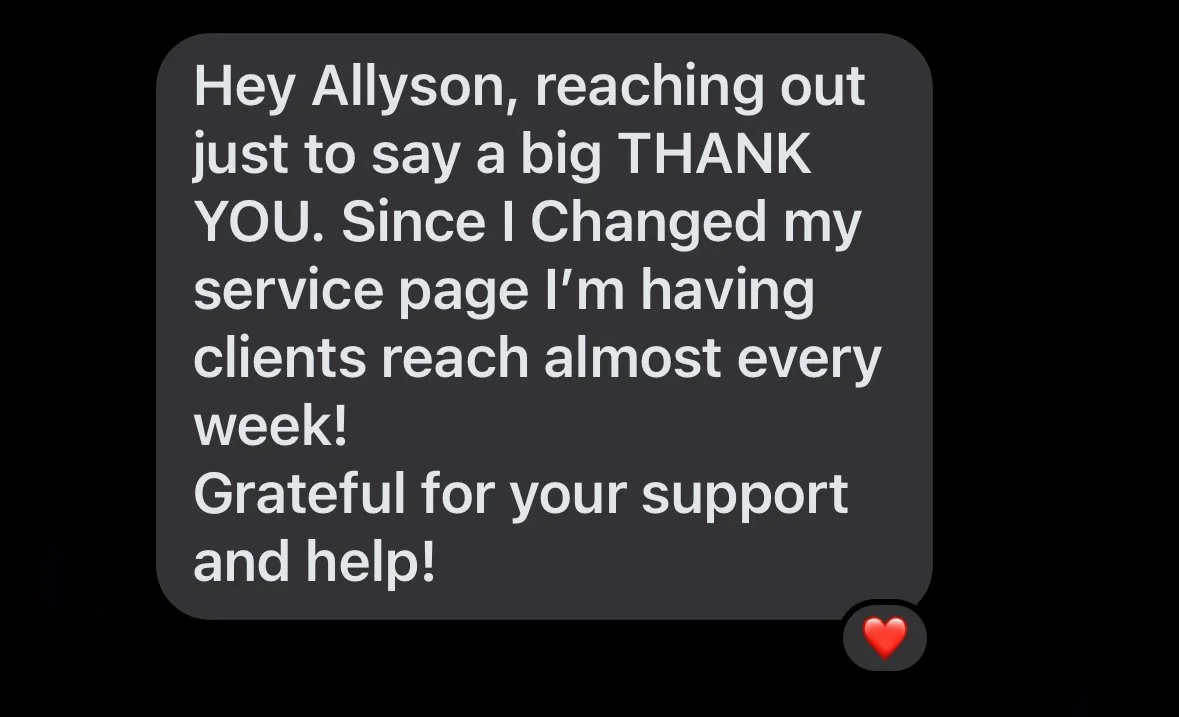
If you raised your fee, dropped insurance, and it’s not working yet, you’re probably not just worried about money.
You’re probably wondering if you’re the problem. Like maybe there’s something obvious that every other private pay therapist already gets and you somehow missed. Maybe you need more training, or another certification, or to get licensed in another state because surely that’s where the cash-pay clients are. Maybe if you just learn one more modality, attend one more workshop, something will click.
I see therapists go through this spiral, and some of them conclude that the answer is to change their role entirely.
They pivot to coaching, or consulting, or speaking, or writing a book, figuring that maybe a different container will be the thing that finally works.
Some of them leave the field altogether. And that’s heartbreaking to watch, because our field loses good clinicians over what is at its core a business problem, not a clinical competency problem.
Pivoting to coaching in particular is worth a closer look, because the idea that an unregulated field with no credential barriers will somehow be easier to charge premium rates in than a profession where you hold a graduate degree and a state license doesn’t actually make sense.
The pricing (and marketing) problem will follow you into coaching. It will follow you everywhere, until you solve it.
You’re not missing something obvious. The reason this feels so hard is that nobody taught you how to do this part.
You were trained to be a clinician, and you’re good at that. The business piece, specifically the piece about communicating who you are and why someone should choose you, just wasn’t part of that training.
One Free Exercise You Can Do in 15 Minutes
If you’re reading this and recognizing your own practice, here’s one thing you can do today that costs nothing and takes about 15 minutes.
Pull up your website and then pull up two or three other therapists in your area. Read all of them back-to-back.
Then ask yourself this: can you point to a single paragraph on your site that only you could have written?
Not a paragraph that mentions your name or your credentials, but one that describes a specific client experience, a specific problem, or a specific way of working that none of those other therapists are saying.
If you can’t find one, if your site reads like it could belong to any of them, that’s your positioning gap right there. Nothing on your site is doing the work of making someone think “this person gets my specific situation,” and until something does, more visibility, more directories, and more credentials aren’t going to change the math.
That’s the place to start. Not with ads, not with SEO, not with another certification, but with the answer to the question: why you, specifically?
The practice you want is on the other side of answering that question.
If you want help answering that question, not with generic advice but with a specific, honest look at your positioning, your messaging, and how private pay clients are finding you, that’s what my business audit for therapists is built for.
In 60 minutes, we’ll figure out what’s not working and you’ll leave with a clear picture of what to fix first.
FAQs About Getting Private Pay Therapy Clients in 2026
-
The short answer is that private pay clients find you, but only if you’ve given them a reason to choose you over a therapist who takes their insurance. That means getting clear on your positioning first (who you help, what you help them with, and why you specifically), and then making sure your online presence reflects that clarity. Directories, SEO, and networking all work better once the foundation is in place. Without it, you’re just getting in front of more people who don’t have a compelling reason to book.
-
Math-wise, it’s actually simpler than most people think. A therapist charging $200 per session who sees 10 clients per week generates roughly $100,000 in annual income before expenses. At $250 a session, you’d need about 8 clients per week. The hard part isn’t the math; it’s filling those appointments consistently with private pay clients who value your approach enough to pay your fees without insurance. That’s a positioning and marketing problem, not a clinical hours problem. The therapists I’ve seen hit this number fastest are the ones who got specific about who they serve, created a clear online presence around that specificity, and then let the marketing do the work of attracting the right people.
-
The “2 year rule” is the common wisdom that it takes about two years to build a full private practice. There’s some truth to it: building professional referral relationships, establishing an online presence, and developing your reputation all take time. But the timeline varies enormously based on your market, your niche specificity, your marketing approach, and whether you’re starting from scratch or transitioning from insurance panels. I’ve seen therapists fill a private pay caseload in under 6 months with strong positioning, and I’ve seen others take 3+ years because they kept adding credentials instead of addressing the business fundamentals. The “2 year rule” is an average, not a law, and the variable that shortens it most is clarity about who you serve.
-
This depends on your practice and your positioning, but my general (hot) take is that free consultation calls are often a sign that your website isn’t doing enough work on its own. If your site clearly communicates who you help, how you help them, and what working with you costs, many clients will book directly without needing a call to be convinced. I don’t use consultation calls in any of my businesses, and my clients book cold. That said, if you do offer them, make sure the call is actually serving the client's needs, not compensating for a positioning gap. If you find yourself “selling” on every call, the issue is usually upstream on your page, not in your sales skills.
Allyson’s Marketing Advice